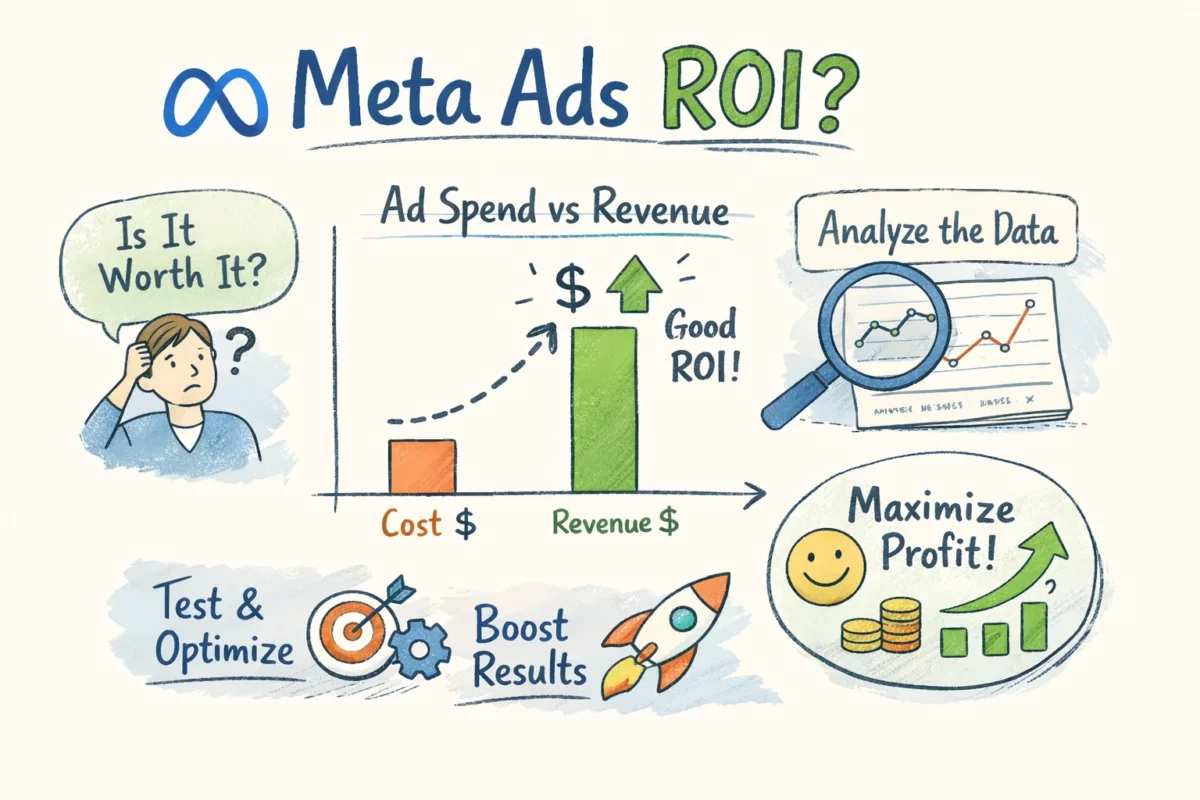
Are Meta ads worth it for your business? You can reach a practical answer in under ten minutes by mapping your unit economics to what Meta delivers. Focus on four inputs: margin, lifetime value, sales cycle, and onsite signal, because those predict paid social effectiveness more than platform hype. This guide explains how to compare Facebook and Instagram with other channels so you make a clear decision based on economics, not optimism.
Below is a five-minute checklist that walks through average order value, gross margin, expected conversion rate, purchase frequency or LTV, and current organic traffic velocity, with thresholds that indicate when paid social ROI is testable. Use the quick baselines, with overall Meta ROAS near 2.79 and a CPA around $19.68, as input while you plug in your numbers. That math will show whether Facebook and Instagram ads are likely to work for your model or whether paid spend would mask deeper funnel problems.
The guide also flags when Meta is the wrong first move: ultra-low margins, very long sales cycles with weak onsite signal, tiny niche audiences, or strict regulatory limits. If the checklist leans no, invest first in channels that build intent and signal such as SEO, targeted search, content partnerships, or account-based outreach. Use the checklist to decide in ten minutes whether to test Meta now or fix fundamentals first.
The bottom line
- Map margin, lifetime value, sales cycle, and onsite signal to reach a fast go/no-go.
- Use Meta baselines, ROAS about 2.79 and CPA around $19.68, as reference points when translating to your economics.
- Run a 7 to 14 day experiment with one hypothesis, one primary conversion, and explicit CPA/ROAS targets to prove ROI.
- Pause a Meta-first approach if margins are very low, sales cycles are long with weak onsite signal, audiences are tiny, or regulation constrains ads.
- Calculate break-even ROAS as 1 divided by contribution margin, then run the checklist and decide whether to scale, optimize, or stop; consider an audit if you need help.
Are Meta ads worth it for your business?
Run the five-minute checklist below and mark each item pass or fail. Use the thresholds as rules of thumb to decide whether to test Meta now or postpone until fundamentals improve.
- Average order value (AOV): AOV > $50 favors testing; lower AOVs require either a very high repeat rate or razor-thin CPA targets to be viable.
- Gross margin: Margin > 40 percent gives room for paid social; under 25 percent usually rules out profitable scaling on Meta without strong LTV.
- Expected conversion rate: Site conversion rate ≥ 2 percent makes paid traffic viable; < 1 percent means fix funnel and CRO first.
- Purchase frequency / LTV: LTV:CAC > 3 is a good target; single-purchase LTV tightens Meta economics quickly.
- Organic traffic velocity: ≥ 1,000 monthly users helps retargeting and creative testing; microscopic traffic implies long, expensive learning phases.
Meta works well for cold reach at scale, creative storytelling, and rapid paid-to-owned funnel acceleration that surfaces LTV faster. Organic channels win on lower ongoing CAC, intent capture, and community trust. Use paid to test creative and seed audiences, rely on organic to sustain retention and reduce long-term CAC, and only scale Meta when the checklist shows positive unit economics. The following section turns this diagnostic into a simple test plan you can run in 30 days.
Benchmarks: cost, reach, and conversion for Meta
Start with realistic baselines: an overall ROAS near 2.79 and a broad CPA reference around $19.68. Conversion rates vary by vertical, commonly from about 2 percent to 14 percent, so treat these numbers as directional benchmarks rather than absolutes. Use them to interpret tests, not to declare victory or failure on a single metric. For additional context on industry benchmark ranges, see this summary of Meta benchmarks and averages.
Translate benchmark aggregates into business-specific targets using your gross margin and LTV. Use break-even ROAS to set realistic ROAS goals before you model CPA.
Convert ROAS into a CPA target by dividing your AOV by the target ROAS. For example, an AOV of $80 with a target ROAS of 2.79 implies ad spend per order of about $28.67. If your LTV is $200 and you are willing to spend 20 percent of LTV on acquisition, that yields a target CPA of $40 to compare against platform baselines.
Expect CPM and CPC pressure from tracking changes; modeled reporting can overstate performance when full-event signal is missing. Server-side options like the Conversions API, aggregated event measurement, and Advantage+ can recover some signal but do not fully restore pre-ATT visibility, so adjust evaluations. Practical steps include running incrementality holdouts, applying a conservative 15 to 25 percent discount to reported ROAS, or inflating CPA targets by roughly 20 percent for iOS-heavy audiences to avoid over-optimistic scaling.
For creative and format strategy, prioritize short-form video and carousel creative paired with objective-based Advantage+ testing versus manual bidding. We often see automated bidding and short-form formats improve CTR and CPA in early tests, so test Reels and interactive lead forms early and measure full-funnel LTV. Treat placement reporting as noisy and rely on end-to-end LTV to judge true performance.
Short test plan: run a 7 to 14 day experiment that proves ROI
Run a focused 7 to 14 day experiment that forces a clear yes or no. Define a one-line hypothesis, pick a single primary conversion event, and set numeric success criteria: target CPA, minimum ROAS, and a required conversion count. A focused hypothesis keeps the team aligned and prevents after-the-fact justification.
Sample hypothesis: “Target lookalikes from our top 1 percent purchasers with add-to-cart creatives to achieve ≤ $35 CPA, ≥ 2.5x ROAS, and 50 purchases within 14 days.” Use the 50 optimization events / 7-day rule to set expectations—this is the common threshold for exiting the learning phase. Generally, you need at least 50 conversions in the target window to exit the learning phase reliably. Those thresholds create an objective pass/fail for whether Meta is working for that audience.
Complete the tracking checklist below before launch, and confirm each item so you avoid chasing phantom conversions. Consistent events and UTM tagging are core to accurate attribution and final ROAS reconciliation.
- Install Meta Pixel plus the Conversions API and confirm event names match your GA4 goals. Pixel without CAPI can undercount conversions and inflate CPA.
- Map GA4 events to your primary conversion and keep consistent UTM tagging across creatives so attribution matches sessions.
- Enable server-side validation and maintain a last-click reconciliation report for final ROAS sanity checks.
Each item reduces misattribution risk that can either overstate or understate Meta effectiveness. Confirming events and tagging prevents wasted spend and wrong strategic decisions.
Budget and creative rules: plan 7 to 14 days, fund each ad set at roughly $50 per day as a practical floor, or use target CPA multiplied by 1 to 5x to reach 50 events faster. Launch 3 to 6 ad variations against a single high-converting landing page and avoid major structural edits for the first seven days because significant changes restart the learning clock. If the test passes, scale winners while preserving tracking and creative variety to avoid signal loss. For guidance on methodological split approaches, review best practices for split testing content, email and social media marketing campaigns.
Client case studies and what to copy
Look for wins that translate into profit, not just vanity metrics. Public ecommerce case studies showing 5x to 8x ROAS often combine video-led funnels, Advantage+ optimization, and reliable server-side event tracking. The tactics behind those results include a steady creative refresh cadence, tight funnel design that reduces dropoff, and robust server-side events to recover attribution; these outcomes come from iterative tests rather than a single perfect setup.
Lead gen and SaaS require a different lens because CPL and LTV behave differently than ecommerce. In the US, lead campaigns commonly face CPMs of $25 to $40 and CTRs near 2.5 percent, so CPL sensitivity and longer LTV windows drive decisions. For reference on current CTR ranges across platforms, see up-to-date CTR benchmarks for Facebook ads. To map CPL to LTV-driven ROI, follow the steps below.
- Calculate contribution per customer: LTV × gross margin.
- Estimate conversion rate from lead to paid customer to get revenue per lead: contribution × conversion rate.
- Divide revenue per lead by CPL to get an LTV-based ROAS proxy.
When you see a 5x ROAS case study, normalize by margin, attribution window, and audience maturity before trusting the headline. Public case studies rarely disclose creative lift or true spend, so treat them as directional benchmarks and build short tests to validate assumptions about creative performance and attribution.
How to read results and choose next steps: scale, optimize, or pause
Stop guessing and use clear math. Start with break-even ROAS, where break-even ROAS equals 1 divided by contribution margin, and contribution margin equals (AOV − COGS − fulfillment − variable costs) ÷ AOV. For example, AOV $100 minus COGS $40, fulfillment $5, and variable costs $5 produces a contribution margin of 0.50 and a break-even ROAS of 2.0.
Apply three simple rules: scale when ROAS is at least 1.2× break-even and CPA is below your CPA target; optimize when ROAS sits within about 10 to 20 percent of break-even and ad-level signals like CTR, frequency, and relevance remain strong; pause when ROAS is below break-even and conversions stay low after basic fixes. A spreadsheet-ready CPA target can be calculated as CPA target = contribution margin × AOV × desired payback share. For example, AOV $100, contribution $50, and a 50 percent payback share gives a CPA target of $25.
Before increasing spend, run a focused optimization playbook in this order and measure impact at each step. Run the list below sequentially and wait 3 to 5 days between grouped changes to avoid restarting the learning phase unnecessarily.
- Fix tracking and implement CAPI to stop underreporting.
- Swap creatives and test short video with a strong hook — and refresh headlines frequently; for headline tips, see this guide on writing Facebook ad headlines that convert.
- Try Advantage+ or mixed automated bidding to let the algorithm stabilize delivery.
- Improve landing page CRO and page speed.
- Broaden audiences to reduce CPMs while monitoring relevance.
Expected lifts vary: tracking fixes can recover 10 to 25 percent of measured performance, creative changes often move CTR and CR by 20 to 40 percent, and CRO can add 10 to 50 percent to conversion rates. Group changes, measure impact, and iterate based on the data rather than gut feel.
Pause Meta when poor ROAS persists after the playbook, when creative is exhausted, or when LTV economics cannot support meaningful CPA. Reallocate incrementally to durable channels such as SEO and content for long-term organic traffic, Google Search for high-intent capture, and TikTok or influencer tests for fresh creative signals. Consider an omni-channel approach and coordinate cross-platform attribution—for an integrated view of Google and YouTube alongside paid social, see our notes on mastering Google, YouTube ads, and omni-channel marketing. Shift 20 to 40 percent of spend while testing alternatives and measure comparative CAC and LTV before a full reallocation. An external audit can speed this decision by identifying quick wins and measurable risks.
Chaosmap’s complementary ad spend audit and next steps
Chaosmap offers a free ad spend audit that answers the single practical question: are Meta ads worth it for your business. The audit reviews account structure, CPA versus LTV analysis, tracking and CAPI health, creative and landing page quality, and produces a prioritized test roadmap with a concise one-page scorecard and a 30 to 60 day checklist of quick wins and measurable risks.
Audit findings convert directly into a testable plan you can run immediately. Deliverables include a clear hypothesis, budget recommendation, suggested channel mix, and a 90-day create-test-scale roadmap with expected ROAS ranges and key risks. A typical two-week pilot runs three audience splits with two creatives each, assigns about 20 percent of the test budget to prospecting, then measures CPA against your LTV assumptions and promotes the winner while instrumenting CAPI for accurate attribution.
Request the free audit or a 20-minute strategy session at https://chaosmap.com/quote, and provide recent ad account access, the last 90 days of conversions, your LTV assumptions, and landing page URLs. We usually return the scorecard in 3 to 5 business days and follow with a short debrief to align on a 7 to 14 day pilot or the 90-day plan.
Are Meta ads worth it? Your next step
If you still ask “are Meta ads worth it,” treat them as a testable investment rather than a marketing wish. Start with the four inputs we outlined: margin, LTV, realistic benchmarks, and creative performance, then compare CPA to your target and model break-even ROAS. Use aggregated benchmarks as starting points, expect variation by audience and offer, and rely on disciplined short tests to prove ROI.